> ## Documentation Index
> Fetch the complete documentation index at: https://docs.minoa.io/llms.txt
> Use this file to discover all available pages before exploring further.
# Work Your Deal from the Deal Page
> One place for your documents, your signals, and the context behind both
Most of what you produce for a deal — the research brief, the value story, the one-pager your champion forwards, the handoff note when it closes — used to live in whichever tool you happened to open. The deal page puts all of it in one place, alongside the calls and notes it was built from.
This walkthrough covers the three tabs and, more usefully, which document to reach for at which point in a deal.
## The three tabs
**Docs** is where you generate, edit, and share the artifacts for this deal.
**Deal intelligence** shows what Minoa has extracted from your context — the customer's priorities and challenges, each backed by the call quote or note it came from. You can edit or dismiss any signal to steer what the AI does with it, and re-analyze when new calls land. Treat it as a working surface, not a report: a dismissed signal is a correction the agent carries forward.
**Context** is the raw material. Account research, connected calls, notes, and files. Everything the documents get built from lives here, so when a generated document says something surprising, this is where you find out why.
## Docs, in three sections
### Deal Documents
Everything that already exists for this deal. Click a row to reopen it, or use the row menu for more options. Your **Account Overview** lives here permanently — it runs automatically rather than being something you pick from a template.
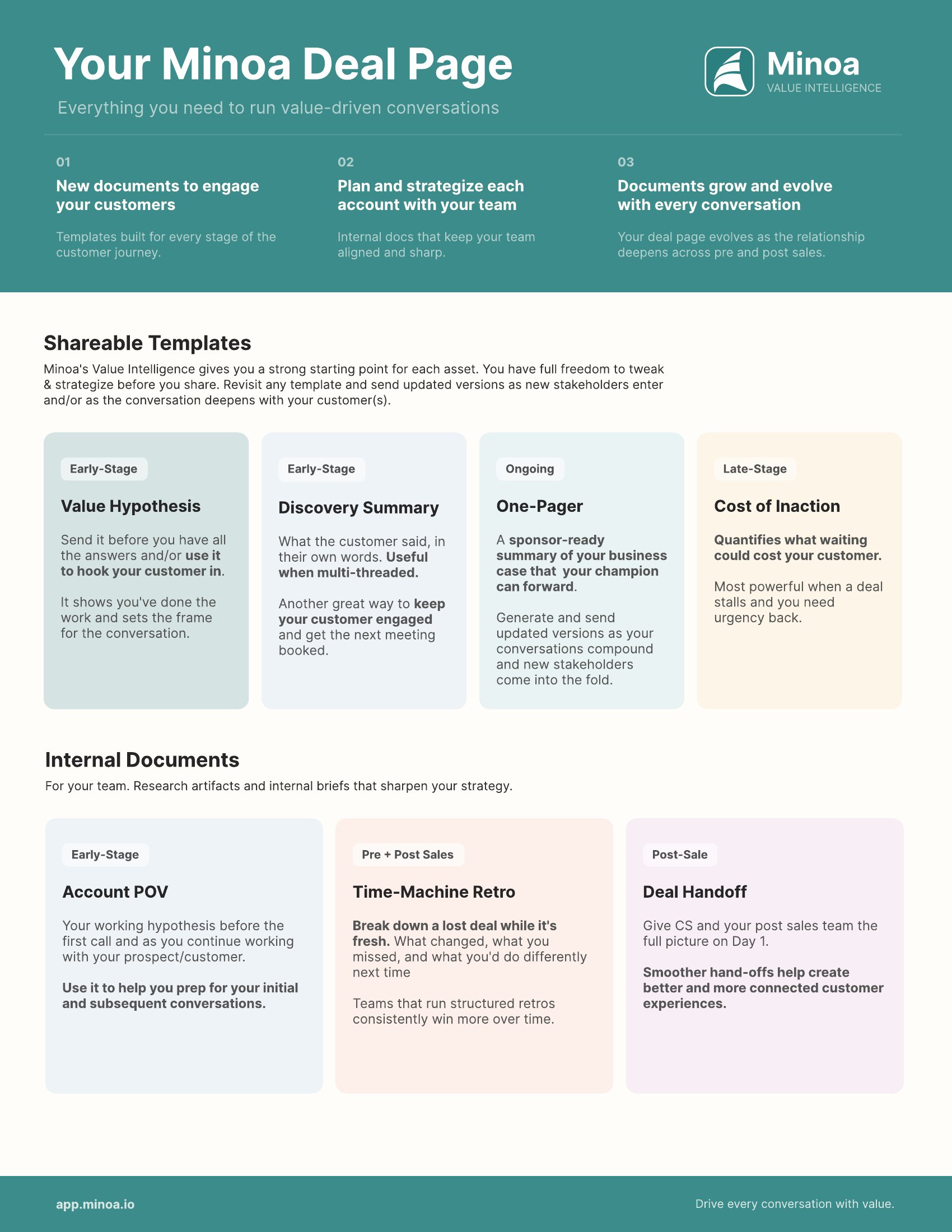
### Shareable Templates
Documents written for the buyer. Pick one and the agent drafts it from your deal context.
| Document | When | What it does |
| :--------------------- | :-------- | :------------------------------------------------------- |
| **Value Hypothesis** | Early | The qualitative value story, before the numbers |
| **Discovery Summary** | Early | What the buyer told you, in their own words, attributed |
| **One-Pager** | Late | A sponsor-ready summary your champion forwards |
| **Cost of Inaction** | Late | What waiting costs, per quarter |
| **Renewal Pitch** | Post-sale | What they paid, what they got, one specific ask |
| **Upsell & Expansion** | Post-sale | Proven value extended to the next team or workflow |
| **Churn Save** | Post-sale | The honest gap, the value at risk, and a dated path back |
### Internal Documents
Research artifacts and briefs for your team only. The **Account POV** is a first-call hypothesis about what's driving the account — see [Prospect a New Account](/pages/recipes/prospect-a-new-account) for how to use it. **Deal Handoff** captures what was sold and what was promised when a deal closes, and **Time-Machine Retro** is its counterpart for the ones you lose.
Internal documents are internal. They contain hedged guesses, stakeholder read-outs, and the reasoning behind your
positioning — none of which is written for a buyer's eyes. Check which section you're in before you share.
## Working with a generated document
Click a template and the agent starts writing in front of you. You'll see it read the account research, pull company context, check your use cases, search transcripts, then draft.
What lands is fully editable. Change anything you disagree with — and do, because your edits teach Minoa how you write and shape what it produces next time.
Two things worth knowing:
* **Add references** runs a second pass that annotates the document with citations back to the calls and notes behind each claim. Hover any reference to see who said it, when, and the quote itself.
* **PDF export** comes from the document header and uses your branding. The Value Hypothesis is the one that also exports to slides; see [Slide export](/pages/business-case/slide-export) for the full deck workflow.
Documents are locked while the references pass runs. Do your editing first, then add references, rather than the
other way round.
## The one-pager
The document your champion actually forwards. It's a sponsor-ready summary of the business case — the value story, the numbers, and the ask, on one page — with a link back to the full case at the bottom for anyone who wants to inspect the model.
Regenerate it whenever the business case changes so what's circulating internally matches what you'd present.
Send the one-pager and the business case link together. The one-pager is what an executive reads; the business case
is what their analyst opens when they're asked to check it. Supplying both saves a round trip and signals you're
not hiding the arithmetic.
## Key takeaways
* **Docs, Deal intelligence, Context** — artifacts, signals, and the raw material behind them.
* **Shareable versus Internal is a real boundary.** Check the section before you send anything.
* **Every document is editable, and your edits teach it.** Rewriting a draft isn't wasted work.
* **Add references after you edit**, not before — the document locks during the pass.
* **The one-pager travels; the business case backs it up.** Send both.
 Regenerate it whenever the business case changes so what's circulating internally matches what you'd present.