
The deal doesn’t stop at closed-won.
Existing customers, more than ever, are asking themselves what value they are actually getting. Companies have to be able to answer that, and the answer has to go further than usage telemetry.
Minoa is continuing to invest in how we help post-sales teams showcase the value story to their customers.
These docs below turn what you sold into the next conversation.
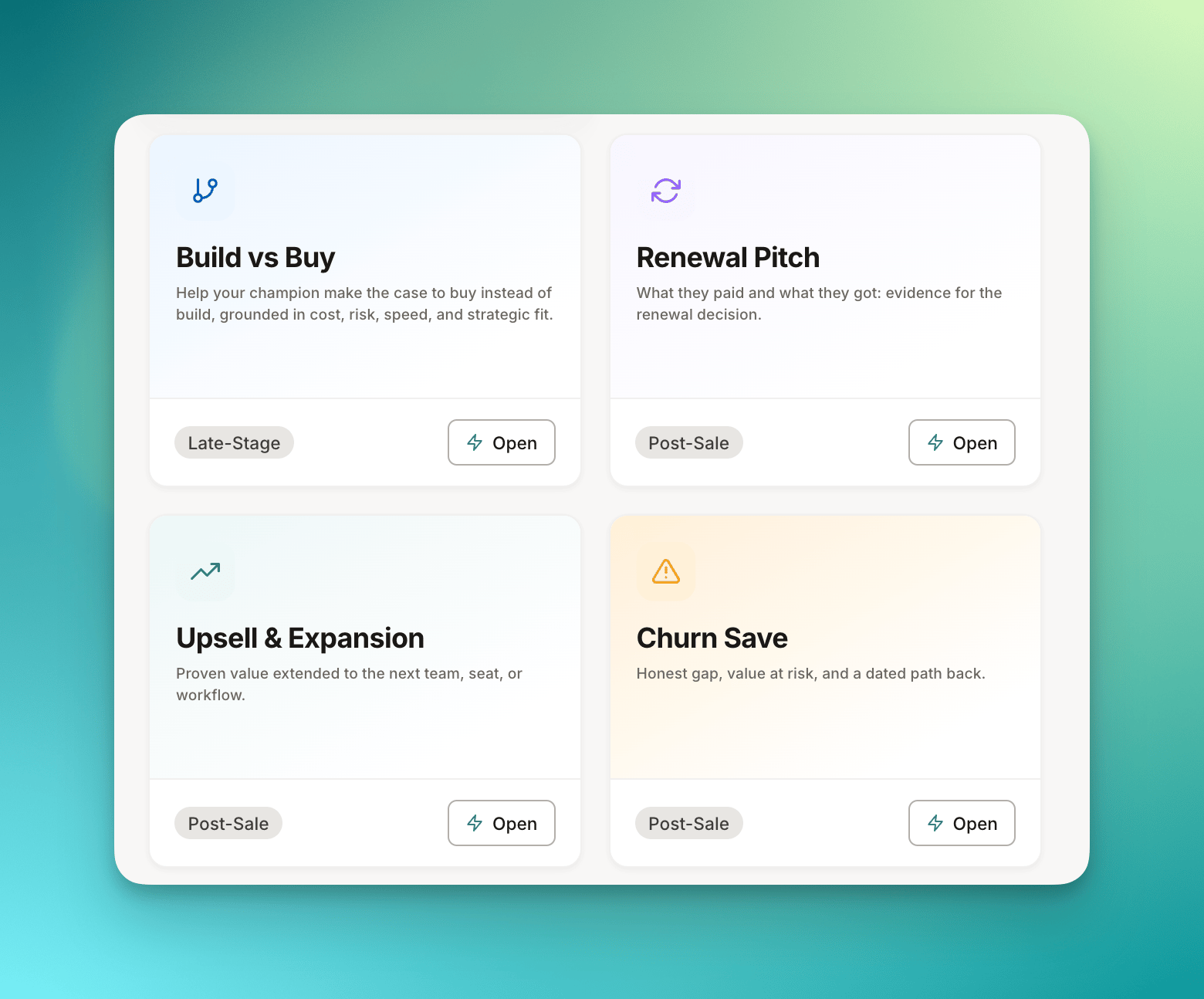
Where these live: the docs section of any deal page.
What changes for you
Walk in knowing exactly what was promised
Continue to build the value story from where the customer left off when they first signed. You don’t have to guess what was sold and how to kick things off with the customer.
Get your prep time back
What used to be an evening of digging through Salesforce, old decks, and Slack threads is now an edit pass. You can continue to add to the value story. The agent is also there to help you strategize and build the narrative.
Defend the renewal on evidence, not adjectives
You walk into the QBR with value projected sitting next to value realized, in the customer’s own numbers. That turns the meeting from a one-sided renewal conversation into a collaborative one.And the story doesn’t have to start at the QBR. Ship it the moment value shows up, so by the time renewal comes around, it’s a year of proof the customer has already seen.
Have the expansion case before you need it
Once the first use case is proven, the next one is sized with a model the customer has already signed off on. Engage your customer with a value story tied to an expansion.An expansion is easier to defend when it’s backed by a value framework and a value story already in motion, rather than a fresh set of numbers nobody has seen yet.
Pick the moment you’re in
The value story and business case don’t end when a customer first signs on. Below are a few ways you can think about using each document at different stages of a customer journey.Build vs Buy
Late-stage Give your champion the case for buying instead of building, in cost, risk, speed, and focus.- Use it when your customer has floated an internal build, or procurement asks why you shouldn’t just build it yourselves.
- Pulls in build cost and the maintenance tail, time to value, the opportunity cost of the engineers who would own it, and the use cases already scoped in this deal.
- Who it’s for: the Account Owner/Relationship Owner, written so the champion can forward it internally without you in the room.
Renewal Pitch
Post-sale What they paid, what they got, and why it’s worth renewing.- Use it when the renewal window opens to help you strategize your approach. Build it for the QBR, use it to kick off the renewal conversation, or use it to supplement your renewal deck.
- Pulls in value projected set against value realized, the original metrics from the business case, and what has changed since signature.
- Who it’s for: the CSM/AM walking into the QBR or the renewal call, and the customer’s economic buyer reading it afterwards.
- Tips: Upload usage data, account notes, or any relevant files, and ask the agent to use the files to build on top of the value story. You can ask the agent to make it customer facing.
Upsell and Expansion
Post-sale Proven value on the first use case, extended to the next team, seat, or workflow.- Use it when the first use case is paying off and there is an obvious next one.
- Pulls in realized value to date, then sizes the next investment with the same model the customer already accepted.
- Who it’s for: the CSM or AM making the case for the next dollar of spend.
- Tips: Upload usage data, account notes, or any relevant files, and ask the agent to use the files to help you strategize on potential upsells and the best way to approach your customer. You can ask the agent to make it customer facing.
Churn Save
Post-sale The honest gap, the value at risk, and a dated path back.- Use it when the renewal is genuinely in doubt. Usage dropped, the champion left, or the budget is under review.
- Pulls in what was promised set against what actually landed, quantified, plus what is still recoverable and by when.
- Who it’s for: the CSM and the exec sponsor. It works because it doesn’t pretend the gap isn’t there.
- Tips: Upload usage data, account notes, or any relevant files, and ask the agent to use the files to build on top of the value story. You can ask the agent to make it customer facing.
Internal documents
Not for the customer. This one is for your team: what was sold, what was promised, and who committed to it.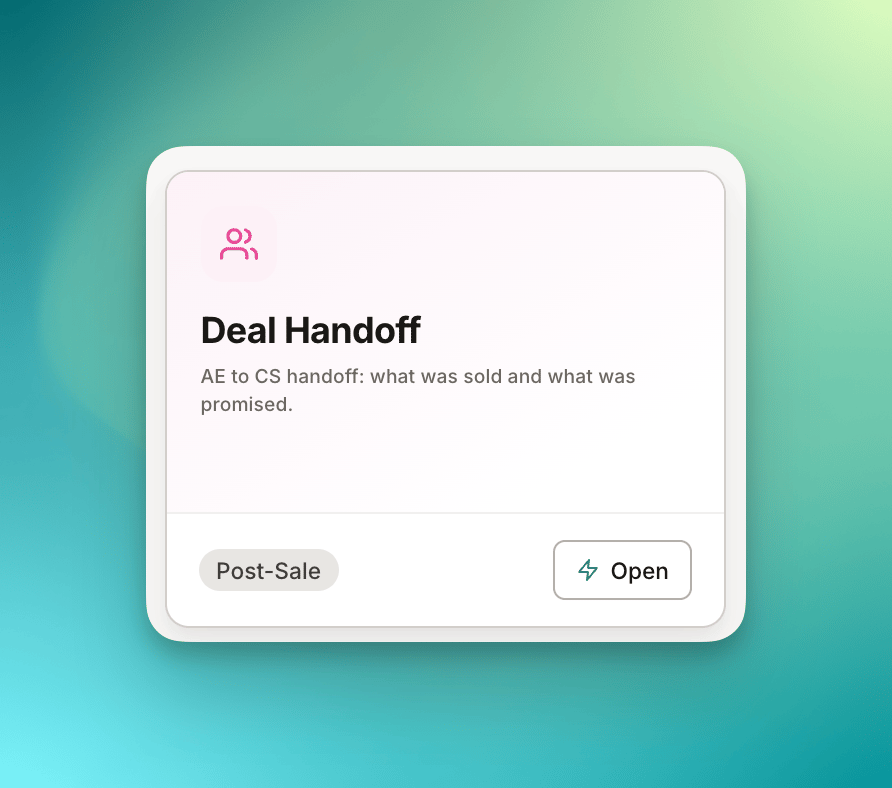
Deal Handoff
Post-sale, internal What was sold and what was promised, in the CSM’s hands on day one.- Use it when the deal closes and the account changes hands.
- Pulls in the signed use cases, the metrics the customer will judge you on, the assumptions behind the numbers, and who made which commitment.
- Who it’s for: AE to CSM. The point is that nothing gets rediscovered in month two.
How it works
1
Open the deal
The business case, the use cases, and the calls are already attached. That is the source material.
2
Pick the moment
Renewal, expansion, risk, handoff. The doc is shaped for that conversation and that audience.
3
Edit and send
You get a draft with the facts already in it. Your judgment is still the part that closes it.
Tips and tricks: usage data that earns its place
Usage is the most available number in the account and the least persuasive one on its own. These are the moves that turn it into something an economic buyer reacts to.Lead with the outcome, not just usage
Lead with the outcome, not just usage
Activity counts describe your product. Outcomes describe their business. Same data, different subject of the sentence. Bridge the quantitative and qualitative data points into a credible story that resonates with your customers.
Attach usage to a metric already in the business case
Attach usage to a metric already in the business case
If the case promised faster ramp, the usage number that matters is days from new hire to first business case. Pick the metric that maps to a promise you made. Everything else is trivia, however good it looks.
Always show the denominator
Always show the denominator
A bare count can’t be judged, so the reader assumes the worst. The base and the direction turn the same number into a rollout story.
Name the gap before they do
Name the gap before they do
If adoption sits with a handful of power users, say so and put a dated plan beside it. A number the customer pokes a hole in costs you the room. The same number, framed first by you, buys credit for everything else in the doc.
Use usage to size the next thing, not to defend the last one
Use usage to size the next thing, not to defend the last one
The team already heavy on the product is where the expansion case is easiest to prove. Usage works better as a targeting tool for where value has landed than as a justification for the renewal itself.
Tell the story as it happens, not when you need something
Tell the story as it happens, not when you need something
Renewal and expansion are the moments you need the story, not the moments to start telling it. If the first time a customer hears about their own results is the week you want something from them, it reads as a sales moment. Share a win after a milestone lands, note a metric moving in a regular check-in, mention it in passing on a support call. By the time renewal or expansion comes around, the story is already familiar, not a pitch.
Date every number
Date every number
These docs get forwarded, and an undated stat becomes a claim you can’t defend three weeks later. “As of 12 Aug” ages honestly and costs you nothing.